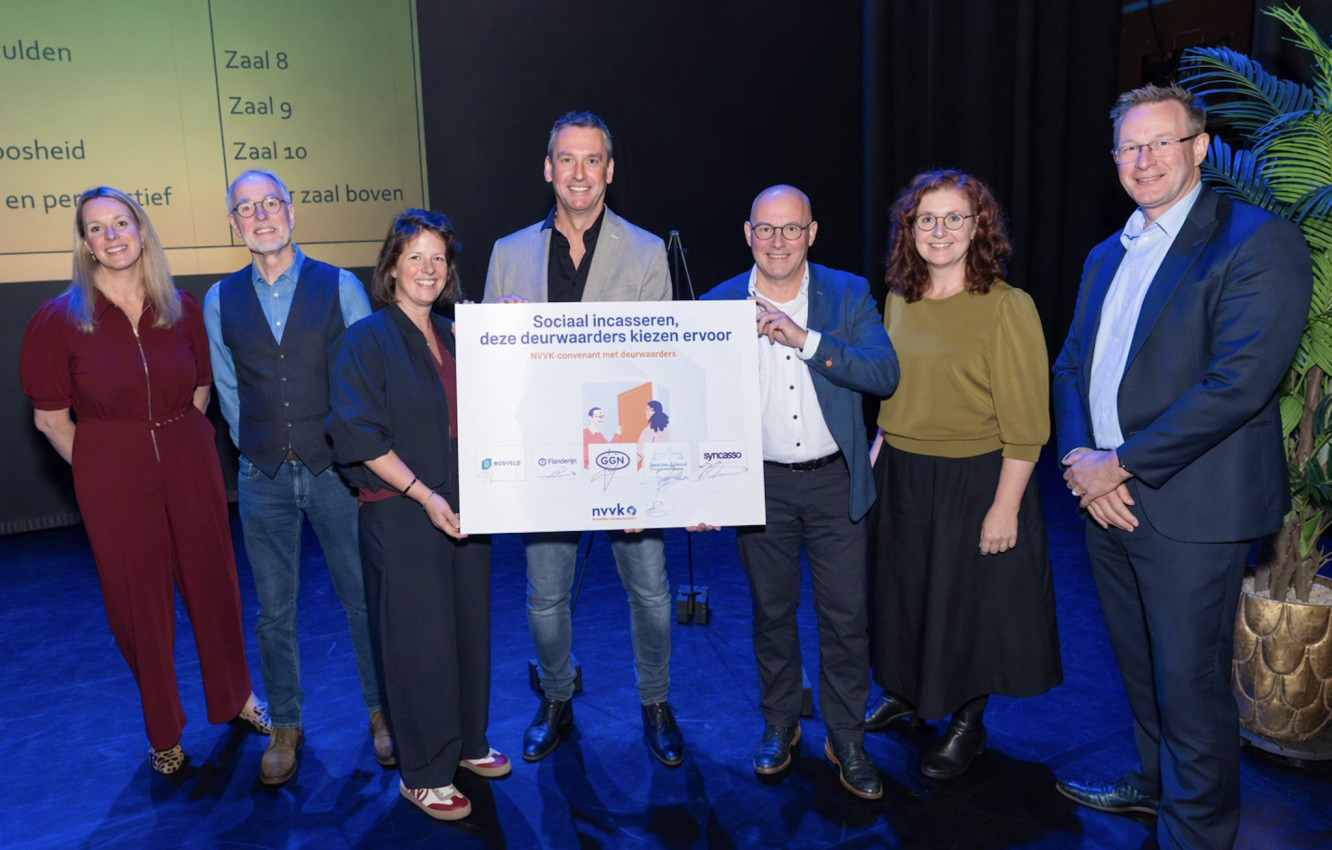
(Source: NVVK)
Anyone seeking help with debts needs peace and stability to work on a solution. This is especially true when a judicial officer is involved in the debt. Therefore, the NVVK is pleased that five bailiff firms are formalizing agreements on debt settlement in a covenant.
Bosveld Incasso en Gerechtsdeurwaarders, Flanderijn, GGN, Janssen & Janssen Incasso en Gerechtsdeurwaarders, and Syncasso promise in the covenant with the NVVK to agree in advance to a debt settlement established by a member of the NVVK.
NVVK debt counselors almost always encounter the participating bailiffs when people with debts report for help. Four of the signatories are among the five largest bailiff firms in the Netherlands. The covenant ensures that from the start of a debt relief process, the same clear agreements apply to a large portion of bailiff files.

Room for the ‘mandatory duty of service’
Judicial officers hold a unique position. They have a ‘mandatory duty of service’: if a client in the judicial phase truly wants a different course than ‘aiming for an amicable settlement’ with debt counselors, the judicial officer must execute that. In the covenant, the judicial officers agree to continue looking at what is possible in such cases to achieve a constructive solution for the person seeking help.
‘With five judicial officers at the table, we show that debt stability is not a paper reality, but a supported way of working. For our members, it means clarity and confirmation: the same agreements for a large portion of the files, especially when a bailiff is involved,’ says Ellen Hennekens, senior policy advisor at the NVVK. ‘We hope and expect that more bailiffs will follow the example of these five.’
The covenant builds on previous collaboration. Syncasso was the first judicial officer to sign a covenant with the NVVK in 2021, followed by Flanderijn in 2022.
Agreements now identical and easier to explain
Since the first NVVK covenant with Syncasso and Flanderijn, much has changed in financial assistance, partly due to the halving of the restructuring period for those seeking help, the arrival of the National Pause Button, and the choice of the NVVK to determine repayment capacity based on the exempt amount. This more often leads to a proposal without repayment capacity.
During the evaluation of the existing agreements with judicial officers, the idea arose not only to update them, but to come to one new uniform set of agreements together with other judicial officers. GGN, Bosveld, and Janssen & Janssen joined in. For financial counselors, this means they no longer have to check per judicial officer which agreements apply. The agreements are identical, up-to-date, and easier to explain. Both towards colleagues and towards those seeking help.
Debt rest through suspension of collection
The agreements follow the principles of the NVVK model covenant. After a Notification is sent by the debt counselor, debt rest takes effect: the judicial officers suspend their collection measures while the debt counselor maps out the situation. An ongoing (wage) attachment is also, in principle, paused.
In addition, the judicial officers give prior approval to a debt settlement proposal that has been established according to NVVK standards. A proposal is only necessary if an impediment was stated during the balance statement. Fixed response times have also been agreed upon, so that processes do not come to an unnecessary standstill.

GGN: ‘One way of working for the sector’
Bailiff GGN is one of the 3 new bailiffs that signed the covenant. Dennis Joustra, operational director at GGN: ‘For us, social debt collection is the norm, so signing the covenant is a logical choice.’
‘Anyone taking the step toward debt relief primarily needs peace and clarity. That only succeeds when we, as a sector, agree on one way of working with debt counseling. That is why it is good that the large bailiff firms are signing together. The debt counselor knows what to expect, regardless of which firm is on the other side.’
‘In essence, we already work as we have now agreed. The difference is that the agreements are now fixed and equal for all parties. Our employees no longer have to figure out what applies per case. If a debt counselor reports, we immediately know what to do. People with debts do not have to wait until we have figured it out.’
What impact does this have for people with problematic debts?
‘Someone who has gathered the courage to seek help should not simultaneously face an attachment or legal procedure. That is why we, in principle, halt the collection so that space is created to work on a solution. To realize that solution, we make agreements with our clients in advance, so that we can immediately accept a proposal from the debt counselor. The faster a settlement is in place, the greater the chance that someone truly finds a way out.’

Bosveld Incasso: ‘Preventing escalation’
As far as Bosveld Incasso is concerned, the signing aligns with a development the company has been pursuing for some time. Director José Olde Olthof: ‘The role of debt collection and the judicial officer is changing: it is not just about collecting a claim, but increasingly about early signaling, preventing escalation, and offering people perspective,’ she says about the signing to the NOS. ‘That requires cooperation throughout the entire chain. That is precisely where the value of this covenant lies for us.’
‘Clients may expect to be paid for what they deliver, while at the same time we have a responsibility to prevent payment problems from unnecessarily growing into problematic debts. Those interests do not have to be mutually exclusive. By sharing information earlier, cooperating better, and organizing appropriate help faster, we can create more value financially and socially.’
What will change in your way of working after the signing?
‘The signing does not mean we are taking a completely different course, but is rather part of the direction Bosveld has already chosen. The covenant helps us to further strengthen that approach and better connect it with debt counseling.’
‘In practice, that means: looking even more closely at signals of financial vulnerability, engaging in conversation about what is really going on, and where possible, making the connection to appropriate help earlier. For our judicial officers and collection specialists, this requires not only knowledge of rules and procedures, but specifically good listening, not judging too quickly, and seeking room for a sustainable solution. The goal remains clear: doing justice to the interests of the client and preventing a situation from escalating further when it is not necessary.’
What impact does this have for people with problematic debts?
‘By better connecting debt collection and debt counseling, we can signal earlier, switch gears faster, and where possible, prevent debts from increasing further. That gives people peace of mind sooner and increases the chance of a solution that is also sustainable in the longer term.’
‘At the same time, we see the covenant as more than an agreement we comply with ourselves. It helps to collectively set a standard for how we, as a market, want to deal with people with problematic debts. We hope that this will lead to more and more parties in the chain working according to the same principles. One covenant does not solve the debt problem. The real impact arises when creditors, collection parties, debt counseling, and the government make the same movement from a shared responsibility. That is exactly why we find this step important.’